 |
The Top Down Game Prototype
A Basic Top Down Shooter
|
Loading...
Searching...
No Matches
|
The Top Down Game Prototype
A Basic Top Down Shooter
|
The armed object. More...
#include <ArmedObject.h>
Public Member Functions | |
| CArmedObject (eObject, eSprite, const Vector2 &) | |
| Constructor. | |
| virtual | ~CArmedObject () |
| Destructor. | |
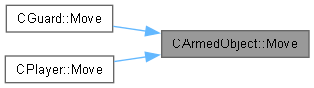
| virtual void | Move () |
| Move object. | |
| virtual void | Draw () |
| Draw object. | |
| void | CreateParticle (const Sage::CParticleDesc2D &) |
 Public Member Functions inherited from CObject Public Member Functions inherited from CObject | |
| CObject (eObject, eSprite, const Vector2 &) | |
| Constructor. | |
| virtual | ~CObject () |
| Destructor. | |
| virtual void | CollisionResponse (const Vector2 &, float, CObject *=nullptr) |
| Collision response. | |
| const eObject | GetType () const |
| Get object type. | |
Protected Member Functions | |
| const Vector2 | GetViewVector () const |
| Compute view vector. | |
| const Vector2 | GetGunOffset () const |
| Get gun offset. | |
| bool | RotateTowards (const Vector2 &) |
| Swivel towards position. | |
| void | DeathFX () |
| Death special effects. | |
Protected Attributes | |
| UINT | m_nHealth = 1 |
| Current health. | |
| float | m_fRotSpeed = 0 |
| Rotational speed. | |
| Vector2 | m_vCenterOffset |
| Sprite center offset. | |
| Vector2 | m_vGunOffset |
| Sprite gun offset. | |
| Sage::CParticleEngine2D * | m_pLocalParticleEngine = nullptr |
| Pointer to particle engine. | |
| Protected Attributes inherited from CObject | |
| eObject | m_eObject = eObject::Unknown |
| Object type. | |
| eSprite | m_eSprite = eSprite::Player |
| Sprite type. | |
| Vector2 | m_vPos |
| Position. | |
| float | m_fRoll = 0 |
| Roll angle. | |
| float | m_fRadius = 0 |
| Bounding circle radius. | |
Friends | |
| class | CObjectManager |
| Object manager needs access so it can manage. | |
Additional Inherited Members | |
| Static Protected Attributes inherited from CCommon | |
| static Sage::CSpriteRenderer * | m_pRenderer = nullptr |
| Pointer to renderer. | |
| static CObjectManager * | m_pObjectManager = nullptr |
| Pointer to object manager. | |
| static Sage::CParticleEngine2D * | m_pParticleEngine = nullptr |
| Pointer to particle engine. | |
| static CPlayer * | m_pPlayer = nullptr |
| Pointer to player character. | |
| static bool | m_bGodMode = false |
| God mode flag. | |
| static bool | m_bShowState = false |
| Show NPC state flag. | |
| static bool | m_bShowBounds = false |
| Show collision circle flag. | |
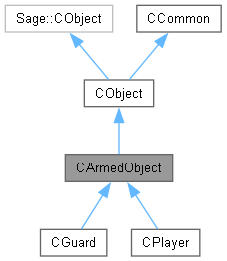
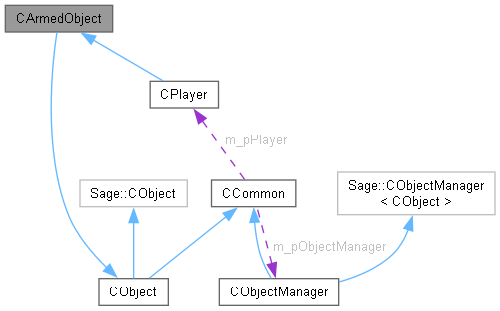
An armed object, that is, an object that has a gun. This class adds to CObject some basic functionality needed to manage a gun, including rotation to face a target and locating the end of the gun barrel.
Create and initialize an object.
| obj | Object type. |
| spr | Sprite type. |
| p | Initial position of object. |
| void CArmedObject::CreateParticle | ( | const Sage::CParticleDesc2D & | d | ) |
Create a local particle.
| d | A particle descriptor. |

|
protected |
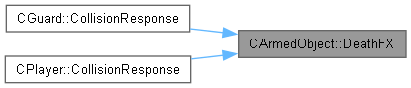
Perform a particle effect to mark death.
|
virtual |
|
protected |
Get the rotated vector offset from the center of the sprite to the gun.

|
protected |
Compute the view vector from the object orientation.

|
virtual |
|
protected |
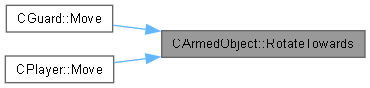
Rotate towards a target point and determine whether sufficiently close to looking directly at it. It first computes theta, the orientation of the vector from the center of the object to the target, then a value diff equal to the difference between the object orientation CArmedObject::m_fRoll and theta. It then computes a positive tracking speed fTrackingSpeed that is faster for larger values of diff, then uses this to compute an angle change fAngleDelta proportional to the tracking speed and frame time. Its rotation speed CArmedObject::m_fRotSpeed is set to plus or minus fTrackingSpeed depending on whether diff is less than -fAngleDelta or greater than fAngleDelta, respectively, and otherwise m_fRoll snaps to theta (the return value will later be true in this case and false otherwise). CArmedObject::m_fRoll is then incremented by an amount proportional to CArmedObject::m_fRotSpeed times the frame time.
| pos | Target point. |
 1.12.0