 |
Newton's Cradle and Friends
Post-Collision Velocities in One Dimension
|
|
Newton's Cradle and Friends
Post-Collision Velocities in One Dimension
|
Fig. 1 shows a common desktop toy called Newton's Cradle (attribution). Why does it act like this? When the first ball collides with the second one, the first ball gets the second ball's velocity, which is zero, and the second ball gets the first ball's velocity. The second ball immediately collides with the third ball, and so the first ball's velocity is transferred down the line to the last ball, which swings out with the first ball's initial velocity.
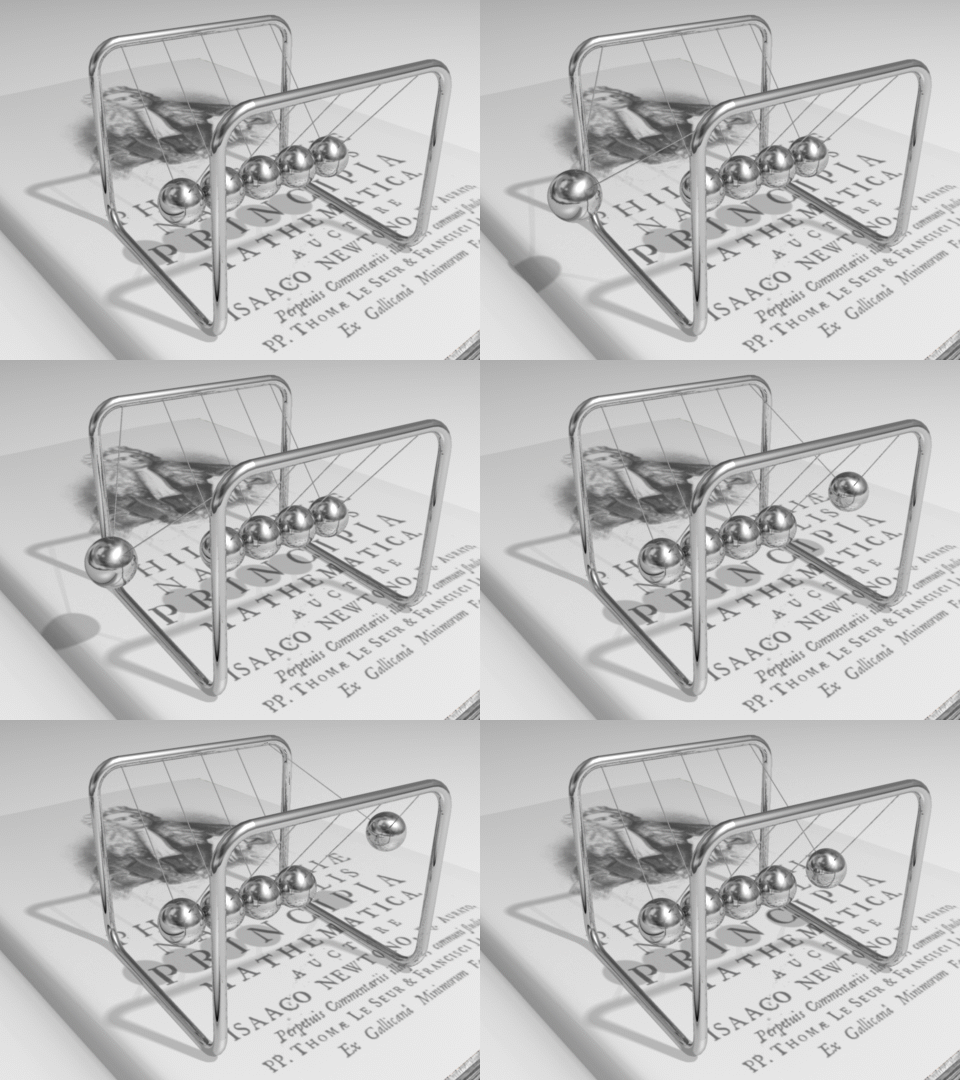
Why is it that balls colliding in one dimension like this swap their velocities? It's actually a consequence of the Law of Conservation of Kinetic Energy and the Law of Conservation of Momentum. This is assuming what is called a perfectly elastic collision. In the real world kinetic energy is lost during a collision and converted to sound and heat energy, which means that Newton's Cradle in the real world doesn't continue infinitely as shown in Fig. 1. Instead, the swings become smaller and smaller over time and the behavior of the balls may even become chaotic.
In Section 1 we will examine what happens in Newton's Cradle in a perfect world in which the balls have the same mass and all collisions are perfectly elastic. This will be used to compute the transfer of velocities in The 8-Ball Pool End Game. In Section 2 we will generalize this to balls of different mass. This will be used to compute the transfer of velocities in The Shapes Library.
Suppose two balls \(B_1\) and \(B_2\) of equal mass move towards each other with speeds \(u_1\) and \(u_2\), respectively, as shown in Fig. 2, left. Suppose their speeds after collision are \(v_1\) and \(v_2\), respectively, as shown in Fig. 2, right. We claim that \(v_1 = u_2\) and \(v_2= u_1\), assuming a perfectly elastic collision between two balls of equal mass \(m \not= 0\).

By the Law of Conservation of Kinetic Energy, the kinetic energy in the system before impact \(mu_1^2/2 +mu_2^2/2\) is the same as the kinetic energy in the system after impact \(mv_1^2/2 +mv_2^2/2\). That is,
\[ mu_1^2/2 +mu_2^2/2 = mv_1^2/2 +mv_2^2/2. \]
Therefore, multiplying both sides of the equation by \(2/m\),
\[ u_1^2 + u_2^2 = v_1^2 + v_2^2. \]
Subtracting \(u_2^2 + v_2^2 \) from both sides:
\[ u_1^2 - v_1^2 = v_2^2 - u_2^2. \]
Therefore,
\[ (u_1 - v_1)(u_1 + v_1) = (v_2 - u_2)(v_2 + u_2). \label{eq1}\tag{Equation 1} \]
We'll come back to this equation in a moment. Now, by the Law of Conservation of Momentum, the amount of momentum in the system before impact \(mu_1 +mu_2\) is the same as the momentum in the system after impact \(mv_1 +mv_2\). That is,
\[ mu_1 + mu_2 = mv_1 +m v_2. \]
Therefore, dividing both sides by \(m\):
\[ u_1 + u_2 = v_1 + v_2.\label{eq2}\tag{Equation 2} \]
Subtracting \(u_2 + v_1\) from both sides:
\[ u_1 - v_1 = v_2 - u_2. \]
We can use this to cancel out the \((u_1 - v_1)\) on the left-hand side of \(\ref{eq1}\) with the \((v_2 - u_2)\) on the right-hand side to give:
\[ u_1 + v_1 = v_2 + u_2, \]
that is, subtracting \(u_2 + v_1\) from both sides
\[ u_1 - u_2 = v_2 - v_1. \label{eq3}\tag{Equation 3} \]
Therefore, if we add both sides of \(\ref{eq2}\) to \(\ref{eq3}\) and divide by 2, this implies that \(u_1 = v_2\), and if we subtract both sides of \(\ref{eq3}\) from \(\ref{eq2}\), this implies that \(u_2 = v_1\), as required.
Suppose two balls \(B_1\) and \(B_2\) of masses \(m_1\) and \(m_2\), respectively move towards each other with speeds \(u_1\) and \(u_2\), respectively, as shown in Fig. 3, left. Suppose their speeds after collision are \(v_1\) and \(v_2\), respectively, as shown in Fig. 3, right. We claim that
\[ v_1 = \frac{2m_2u_2 + (m_1 - m_2)u_1}{m_1 + m_2} \]
and
\[ v_2 = \frac{2m_1u_1 + (m_2 - m_1)u_2}{m_1 + m_2} \]
assuming a perfectly elastic collision.

By the Law of Conservation of Kinetic Energy, the kinetic energy in the system before impact \(m_1u_1^2/2 + m_2u_2^2/2\) is the same as the kinetic energy in the system after impact \(m_1v_1^2/2 + m_2v_2^2/2\). That is,
\[ m_1u_1^2/2 + m_2u_2^2/2 = m_1v_1^2/2 + m_2v_2^2/2. \]
Therefore, multiplying both sides of the equation by \(2\),
\[ m_1u_1^2 + m_2u_2^2 = m_1v_1^2 + m_2v_2^2. \]
Subtracting \(m_2u_2^2 + m_1v_1^2\) from both sides and factoring out the masses:
\[ m_1(u_1^2 - v_1^2) = m_2(v_2^2 - u_2^2). \]
Therefore,
\[ m_1(u_1 - v_1)(u_1 + v_1) = m_2(v_2 - u_2)(v_2 + u_2). \label{eq4}\tag{Equation 4} \]
We'll come back to this equation in a moment. Now, by the Law of Conservation of Momentum, the amount of momentum in the system before impact \(m_1u_1 +m_2u_2\) is the same as the momentum in the system after impact \(m_1v_1 +m_2v_2\). That is,
\[ m_1u_1 + m_2u_2 = m_1v_1 +m_2 v_2. \label{eq5}\tag{Equation 5} \]
Subtracting \(m_2u_2 + m_1v_1\) from both sides and factoring out the mass:
\[ m_1(u_1 - v_1) = m_2(v_2 - u_2). \]
We can use this to cancel out the \(m_1(u_1 - v_1)\) on the left-hand side of \(\ref{eq4}\) with the \(m_2(v_2 - u_2)\) on the right-hand side to give:
\[ u_1 + v_1 = v_2 + u_2, \]
that is, subtracting \(u_2 + v_1\) from both sides
\[ u_1 - u_2 = v_2 - v_1.\label{eq6}\tag{Equation 6} \]
Subtracting \(m_2\) times \(\ref{eq6}\) from \(\ref{eq5}\),
\[ (m_1 - m_2)u_1 + 2m_2u_2 = (m_1 + m_2)v_1, \]
which implies that (assuming \(m_1+m_2 \not= 0\)):
\[ v_1 = \frac{2m_2u_2 + (m_1 - m_2)u_1}{m_1 + m_2}\label{eq7}\tag{Equation 7} \]
as required.
Adding \(m_1\) times \(\ref{eq6}\) to \(\ref{eq5}\),
\[ 2m_1u_1 + (m_2 - m_1)u_2 = (m_1 + m_2)v_2, \]
which implies that (assuming \(m_1+m_2 \not= 0\)):
\[ v_2 = \frac{2m_1u_1 + (m_2 - m_1)u_2}{m_1 + m_2}\label{eq8}\tag{Equation 8} \]
as required.
 1.12.0