 |
SAGE
A Simple Academic Game Engine
|
Loading...
Searching...
No Matches
|
SAGE
A Simple Academic Game Engine
|
The keyboard handler. More...
#include <SageKeyboard.h>
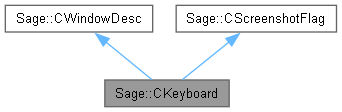
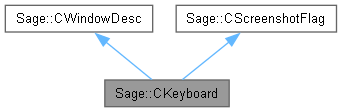
Public Member Functions | |
| CKeyboard () | |
| Constructor. | |
| void | GetState () |
| Poll the keyboard state. | |
| const bool | Down (const WPARAM) const |
| Check for key down. | |
| bool | TriggerDown (const WPARAM) |
| Check for key going down. | |
| bool | TriggerUp (const WPARAM) |
| Check for key going up. | |
| bool | TriggerDown () |
| Check for any key going down. | |
| bool | TriggerUp () |
| Check for any key going up. | |
Private Member Functions | |
| bool | Trigger (const WPARAM, bool) |
| Check for key changing state. | |
| bool | Trigger (bool) |
| Check for any key changing state. | |
Private Attributes | |
| BYTE | m_pState [NUMKEYS] = {0} |
| Space for current state of keys. | |
| BYTE | m_pOldState [NUMKEYS] = {0} |
| Space for current state of keys. | |
Static Private Attributes | |
| static const UINT | NUMKEYS = 256 |
| Number of keys on the keyboard. | |
Additional Inherited Members | |
 Static Protected Attributes inherited from Sage::CWindowDesc Static Protected Attributes inherited from Sage::CWindowDesc | |
| static HWND | m_Hwnd = 0 |
| Window handle. | |
| static HINSTANCE | m_hInst = 0 |
| Instance handle. | |
| static bool | m_bExitSizeMove = true |
| User just finished moving/resizing window. | |
| Static Protected Attributes inherited from Sage::CScreenshotFlag | |
| static bool | m_bScreenShot = false |
| Screenshot flag. | |
This is a polled keyboard handler. Its GetState() function must be called once per frame. The keyboard state from the previous frame is retained so that queries can determine whether a key changed state. Mouse button clicks are also handled here using virtual key codes VK_LBUTTON, VK_MBUTTON, VK_RBUTTON, VK_XBUTTON1, and VK_XBUTTON2.
| CKeyboard::CKeyboard | ( | ) |
The constructor initializes all key states to zero.
| const bool CKeyboard::Down | ( | const WPARAM | k | ) | const |
Check whether a key is currently down. This function assumes that GetState() has been called recently to get the current keyboard state.
| k | Virtual key code of key to check. |
| void CKeyboard::GetState | ( | ) |
Use the Windows API GetKeyboardState() function to get the state of all 256 keys on the keyboard. The results are stored as an array of bytes in m_pState, while the previous state is also stored in m_pOldState. If the P key is triggered down, then a screenshot save is triggered by setting g_bScreenShot to true. The actual save gets done in CRenderer3D::EndFrame. If VK_ESCAPE is triggered down, then game exit is indicated by posting a WM_DESTROY message to the window handle.

|
private |
Check whether any key changed state in a particular direction, not including the ESC key or the function keys F1 through F12. This function assumes that GetState() has been called recently to get the current keyboard state.
| bDown | True if we're checking for key down, false if up. |

|
private |
Check whether a key has just changed state, ie. whether it just went up or just went down. This function assumes that GetState() has been called recently to get the current keyboard state.
| k | Virtual key code of key to check. |
| bDown | True if we are checking for key down, false for key up. |
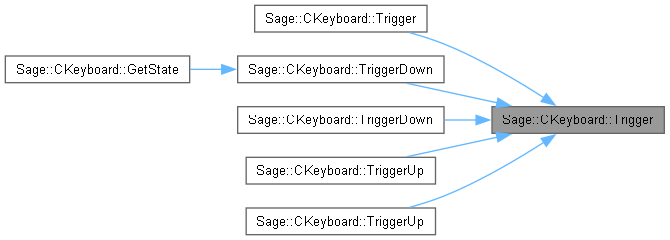
| bool CKeyboard::TriggerDown | ( | ) |
Check whether any key went down, not including the ESC key or the function keys F1 through F12. This includes the mouse buttons. This function assumes that GetState() has been called recently to get the current keyboard state.


| bool CKeyboard::TriggerDown | ( | const WPARAM | k | ) |
Check whether a key went down. This function assumes that GetState() has been called recently to get the current keyboard state.
| k | Virtual key code of key to check. |

| bool CKeyboard::TriggerUp | ( | ) |
Check whether any key went up, not including the ESC key or the function keys F1 through F12. This includes the mouse buttons. This function assumes that GetState() has been called recently to get the current keyboard state.

| bool CKeyboard::TriggerUp | ( | const WPARAM | k | ) |
Check whether a key went up. This function assumes that GetState() has been called recently to get the current keyboard state.
| k | Virtual key code of key to check. |

 1.12.0