 |
The Top Down Game Prototype
A Basic Top Down Shooter
|
Loading...
Searching...
No Matches
|
The Top Down Game Prototype
A Basic Top Down Shooter
|
The game class. More...
#include <Game.h>
Public Member Functions | |
| ~CGame () | |
| Destructor. | |
| void | Initialize () |
| Initialize the game. | |
| void | ProcessFrame () |
| Process an animation frame. | |
| void | Release () |
| Release the renderer. | |
Private Member Functions | |
| void | LoadSprites () |
| Load sprites. | |
| void | LoadSounds () |
| Load sounds. | |
| void | CreateObjects () |
| Create game objects. | |
| void | BeginGame () |
| Begin playing the game. | |
| void | KeyboardHandler () |
| The keyboard handler. | |
| void | MouseHandler () |
| The mouse handler. | |
| bool | ControllerHandler () |
| The controller handler. | |
| void | RenderFrame () |
| Render an animation frame. | |
| void | ProcessGameState () |
| Process game state. | |
| void | DrawFrameRateText () |
| Draw frame rate text to screen. | |
| void | FollowCamera () |
| Make camera follow player character. | |
Private Attributes | |
| eGameState | m_eGameState = eGameState::Loading |
| Game state. | |
| bool | m_bDrawFrameRate = false |
| Draw the frame rate. | |
| Sage::CEventTimer * | m_pEndWaitEvent = nullptr |
| End game wait event. | |
Additional Inherited Members | |
 Static Protected Attributes inherited from CCommon Static Protected Attributes inherited from CCommon | |
| static Sage::CSpriteRenderer * | m_pRenderer = nullptr |
| Pointer to renderer. | |
| static CObjectManager * | m_pObjectManager = nullptr |
| Pointer to object manager. | |
| static Sage::CParticleEngine2D * | m_pParticleEngine = nullptr |
| Pointer to particle engine. | |
| static CPlayer * | m_pPlayer = nullptr |
| Pointer to player character. | |
| static bool | m_bGodMode = false |
| God mode flag. | |
| static bool | m_bShowState = false |
| Show NPC state flag. | |
| static bool | m_bShowBounds = false |
| Show collision circle flag. | |
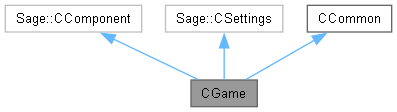
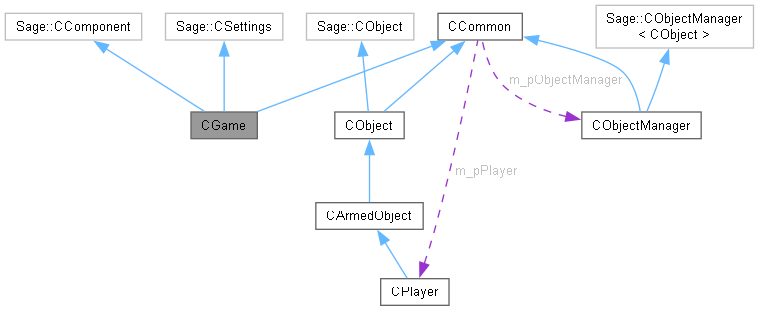
The game class is the object-oriented implementation of the game. This class must contain the following public member functions. Initialize() does initialization and will be run exactly once at the start of the game. ProcessFrame() will be called once per frame to create and render the next animation frame. Release() will be called at game exit but before any destructors are run.
| CGame::~CGame | ( | ) |
Delete the particle engine, the object manager, and the wait event. The renderer needs to be deleted before this destructor runs so it will be done elsewhere.
|
private |
Call this function to start a new game. This should be re-entrant so that you can restart a new game without having to shut down and restart the program. Clear the particle engine to get rid of any existing particles, delete any old objects out of the object manager and create some new ones.


|
private |
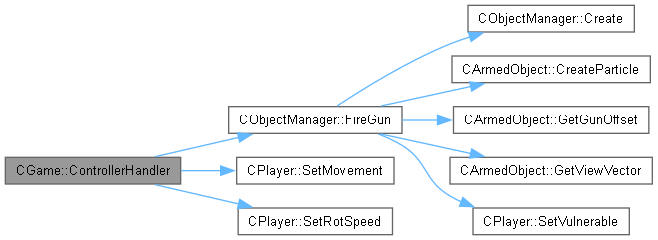
Poll the XBox controller state and respond to the controls there.

|
private |
Ask the object manager to create the game objects.


|
private |
Draw the current frame rate to a hard-coded position in the window. The frame rate will be drawn in a hard-coded position using the font specified in GameSettings.xml.

|
private |
Make the camera follow the player, but don't let it get too close to the edge unless the world is smaller than the window, in which case we just center everything.


| void CGame::Initialize | ( | ) |
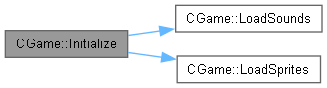
Create, initialize, and load the renderer and the audio player. Create the wait event, the particle engine, and the object manager.

|
private |
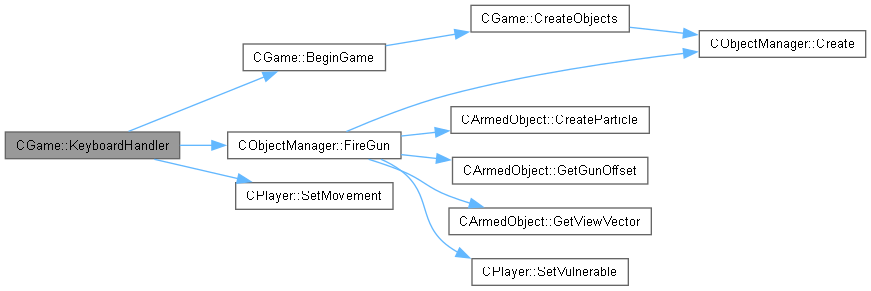
Poll the keyboard state and respond to the key presses that happened since the last frame. The keys are identified using virtual-key codes. Also mouse buttons get handled here too.

|
private |
Create a media list Sage::CMediaList of eSound. For each sound, insert into the media list a pair consisting of an instance of the sound enumerated type eSound and the corresponding string used in the name field in a <sound> tag in GameSettings.xml. Pass the media list to the sound manager for loading.

|
private |
Create a media list Sage::CMediaList of eSprite. For each sprite, insert into the media list a pair consisting of an instance of the sprite enumerated type eSprite and the corresponding string used in the name field in a <sprite> tag in GameSettings.xml. Pass the media list to the renderer for loading.

|
private |
Poll the mouse state and respond to mouse motion that happened since the last frame. Button presses are handler by the keyboard handler.


| void CGame::ProcessFrame | ( | ) |
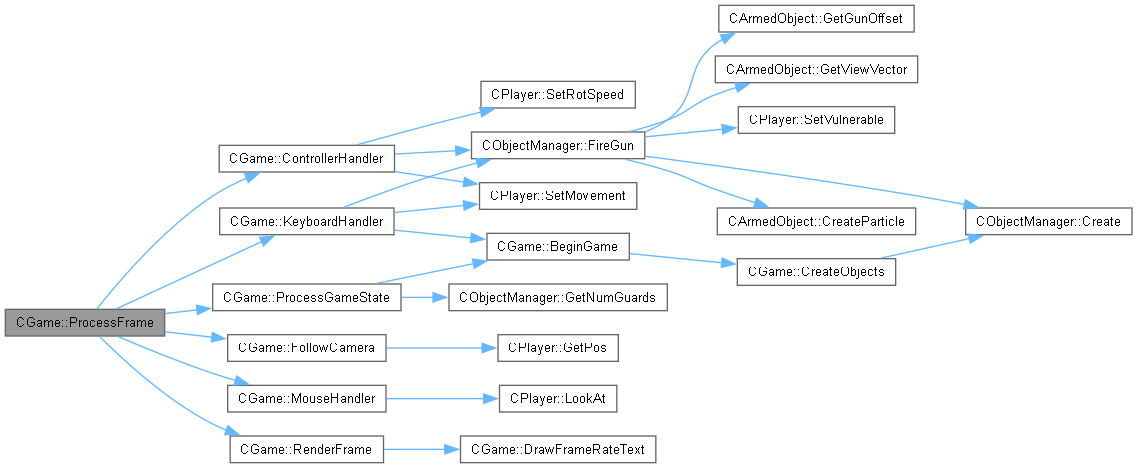
This function will be called regularly to process and render a frame of animation, which involves the following. Handle inputs. Notify the audio player at the start of each frame so that it can prevent multiple copies of a sound from starting on the same frame.
Move the game objects and the camera. Render a frame of animation.

|
private |
Process any changes to the current game state. If the game is in state eGameState::Loading and both the renderer and the sound manager have finished loading (which may or may not be multithreaded), then begin the game. If the game is currently playing, then if the player has been killed or all NPCs have been killed, then enter the wait state. If the game has been in the wait state for longer than 3 seconds, then restart the game.


| void CGame::Release | ( | ) |
Release all of the DirectX12 objects by deleting the renderer.

|
private |
Ask the object manager to draw the game objects. The renderer is notified of the start and end of the frame so that it can let Direct3D do its pipelining jiggery-pokery.


 1.12.0