 |
The Pinball Game
Game Physics with Bespoke Code
|
Loading...
Searching...
No Matches
|
The Pinball Game
Game Physics with Bespoke Code
|
A gate. More...
#include <Gate.h>
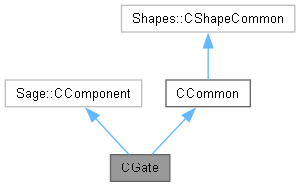
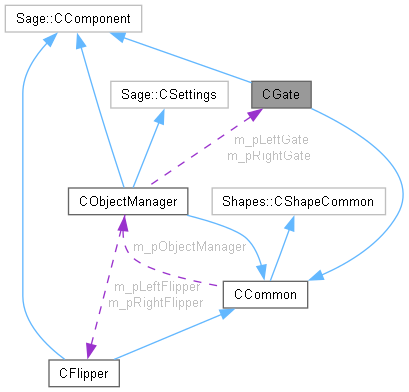
Public Member Functions | |
| CGate (Shapes::CLineSeg *) | |
| Constructor. | |
| ~CGate () | |
| Destructor. | |
| bool | NarrowPhase (Shapes::CDynamicCircle *) |
| Narrow phase. | |
Private Attributes | |
| Shapes::CLineSeg * | m_pLineSeg = nullptr |
| Pointer to line segment. | |
Additional Inherited Members | |
 Static Protected Attributes inherited from CCommon Static Protected Attributes inherited from CCommon | |
| static Sage::CSpriteRenderer * | m_pRenderer = nullptr |
| Pointer to the renderer. | |
| static CObjectManager * | m_pObjectManager = nullptr |
| Pointer to the object manager. | |
| static UINT | m_nMIterations = 4 |
| Number of motion iterations. | |
| static UINT | m_nCIterations = 1 |
| Number of collision iterations. | |
| static float | m_fFrequency = 60.0f*m_nMIterations |
| Frequency, number of physics iterations per second. | |
| static eDrawMode | m_eDrawMode = eDrawMode::Background |
| Draw mode. | |
| static bool | m_bBallInPlay = false |
| Is there a ball currently in play? | |
| static UINT | m_nScore = 0 |
| Current score. | |
A gate allows circles to cross in one direction only. It's essentially a line segment with some code that handles the crossing-in-one-direction requirement. More specifically, if the circle's velocity is in the opposite direction to the line segment's normal vector CLineSeg::m_vNormal and the circle's speed is larger than some threshold, then the circle passes through. Otherwise it bounces off of the line segment. Recall that the direction of CLineSeg::m_vNormal depends on the order in which CLineSeg's end points were specified, so make sure you get it right.
| CGate::CGate | ( | Shapes::CLineSeg * | p | ) |
Construct a closed and unlatched gate from a line segment.
| p | Pointer to a line segment. |
| bool CGate::NarrowPhase | ( | Shapes::CDynamicCircle * | p | ) |
If a dynamic circle collides with a gate and it is moving in the correct direction and is fast enough, then the gate opens and the dynamic circle is allowed through. Otherwise the dynamic circle bounces off the gate as usual.
| p | Pointer to a dynamic circle. |

 1.12.0