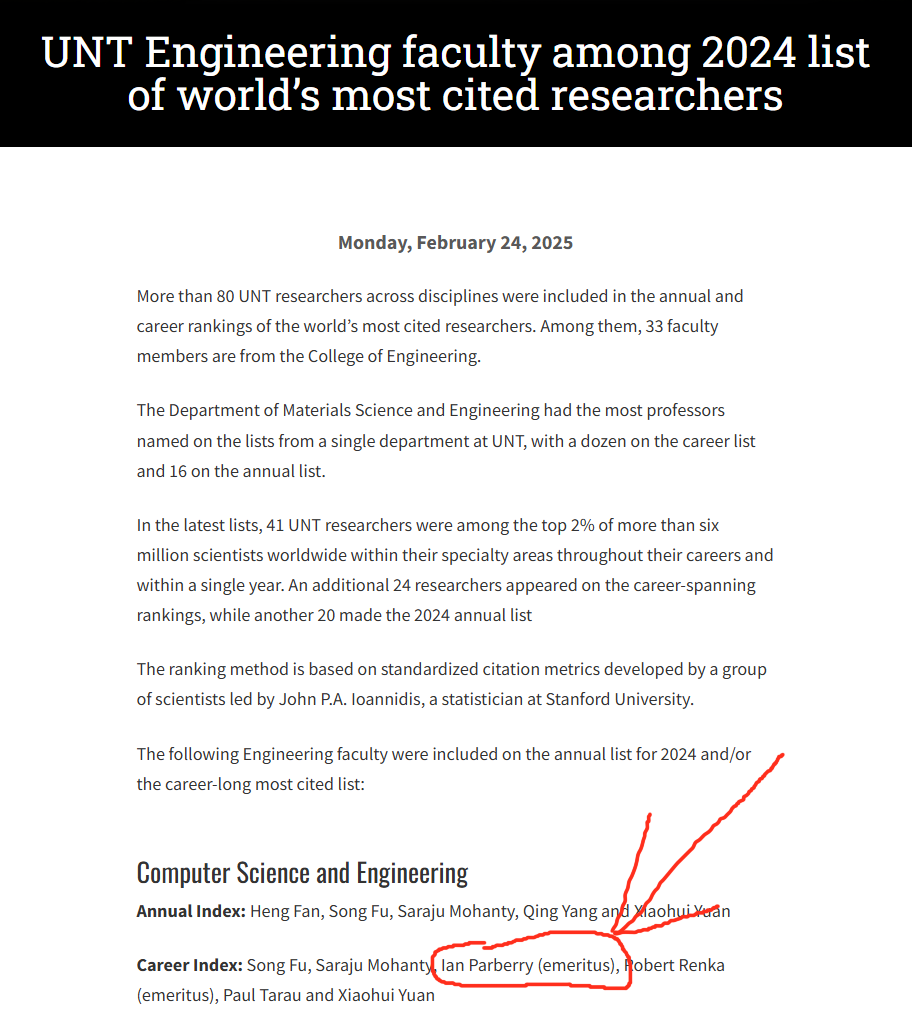
I was a little surprised to see this 2025 article from UNT's Research and Innovation journalists which lists me as being in the top 2% of scientists in my field over the course of my career to 2024 "based on standardized citation metrics developed by a group of scientists led by John P.A. Ioannidis, a statistician at Stanford University." (I'm not sure how long that link will stay active; here is a screenshot instead.) I was immediately curious about what that meant exactly and although confident in all research done by Ioannidis and his coauthors (based on past experience), I am not so confident in the ability of journalists not to mislead readers, either intentionally or unintentionally (also based on past experience). Fortunately, the data from Ioannidis et al. is available from the Elsevier Data Repository here. According to the title page,
"Career-long data are updated to end-of-2023 and single recent year data pertain to citations received during calendar year 2023. The selection is based on the top 100,000 scientists by c-score (with and without self-citations) or a percentile rank of 2% or above in the sub-field. This version (7) is based on the August 1, 2024 snapshot from Scopus, updated to end of citation year 2023. This work uses Scopus data. Calculations were performed using all Scopus author profiles as of August 1, 2024."After downloading this repository and opening the file
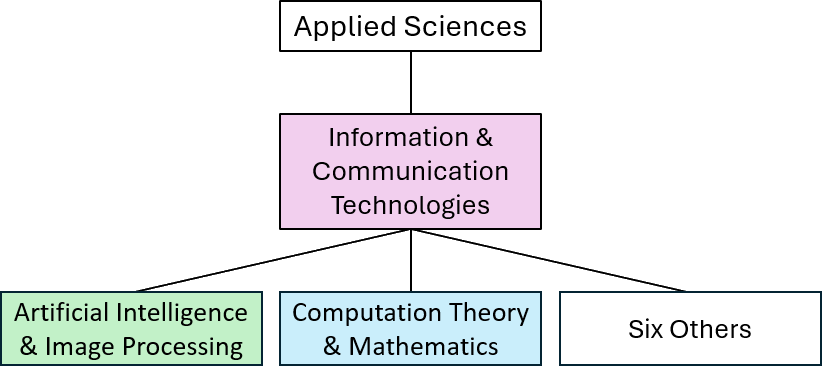
Fig. 1: My Science Metrix field (pink) with the two subfields listed by Ioannidis et al..
The Science Metrix table lists eight subfields of Information and Communication Technologies (see Fig.1), including Artificial Intelligence & Image Processing and Computation Theory & Mathematics, which Ioannidis et al. list in the Microsoft® Excel® file mentioned above as my first and second subfields, respectively (columns AN and AP). The six subfields from the Science Metrix table not listed in Fig. 1 are Computer Hardware & Architecture, Distributed Computing, Information Systems, Medical Informatics, Networking & Telecommunications, and Software Engineering. Admittedly, this is a poor way of describing Computer Science research areas compared to, say, the ACM Computing Classification System.
My rank in the sub-field Artificial Intelligence & Image Processing (not counting self-citations) is 7,350 (column AU) out of 399,065 (column AV). Since 7,350 divided by 399,065 is slightly more than 0.018, this puts me in the top 1.8%. This explains why I am in the table at all: it is because (as quoted above) I have "a percentile rank of 2% or above in the sub-field". If you are curious about how rank is determined by Ioannidis et al., see Updated science-wide author databases of standardized citation indicators, PLOS Biology, 2020.
The above information is based on Version 7 of the data, V7, 15 September 2024, which is the latest available at time of writing. My name also appears in V6, 3 October 2023 (line 193,262), V5, 2 November 2022 (line 183,965), and V4, 9 October 2022 (line 184,704). However, it does not appear in V3, 19 October 2021, V2, 7 October 2020, or V1, 5 July 2019. Either something in the data has changed, or I have entered the top 2% of scientists only since 2022, which happens to be the year of my retirement.